
The Real Cost of Dirty Solar Panels for Port Macquarie Homeowners

A solar system can look fine from the ground and still be quietly costing a Port Macquarie household hundreds of dollars a year.
For a typical four-bedroom family home, household overheads are already a constant balancing act. With two adults, two kids, hot water, cooking, washing, cooling, pool pumps or extra appliances, annual electricity bills can sit around the $2,800 mark, even after sensible energy habits.
That is why many local homes have invested in 6.5 kW or 10 kW solar systems. The usual strategy is simple: run the dishwasher, washing machine, pool pump, chargers and other heavy loads during the day, when the panels are making power.
The issue is that this strategy depends on the panels actually producing close to their expected output. If a solar array sits under tree canopy, picks up coastal salt, cops bird droppings, or has not been cleaned for two years, the financial return can fall sharply.
This is where dirty solar panels become more than a cosmetic problem. They change the economics of the whole system.

How the 3 cent feed-in tariff changes the value of solar
Solar panels create electricity, but the return depends on where that electricity goes.
In New South Wales, many households now receive a low feed-in tariff for exported solar, often around 3 cents per kilowatt-hour, depending on the retailer and plan. That means power sent back to the grid is not worth much.
The real value of solar comes from using it inside the home.
If grid electricity costs around 30 cents per kilowatt-hour, then every kilowatt-hour used directly from the solar system avoids buying that unit from the retailer. This is often called a behind-the-meter saving.
So the gap is large:
Solar power use | Approximate value per kWh |
Used inside the home instead of grid power | $0.30 |
Exported to the grid | $0.03 |
This difference is the key to understanding the real cost of dirty panels.
If a household uses roughly 60% of its solar generation directly, a drop in panel output does not just reduce a tiny export credit. It can force the home to buy more daytime power from the grid at the higher retail rate.
For example, if dirt stops the system from producing 1 kWh during a sunny afternoon, and that power would have run the washing machine or pool pump, the household may now buy that same energy back at around 30 cents.
That is a very different loss from missing out on a 3 cent export credit.
The real cost is based on weighted solar value
To keep the maths realistic, it helps to use a blended value for each lost kilowatt-hour.
For this example, assume:
60% of solar is used directly in the home
40% is exported to the grid
Imported electricity costs about 30 cents per kWh
Exported electricity earns about 3 cents per kWh
The weighted value of lost solar generation is:
Portion of lost solar | Value calculation | Value |
60% self-consumed | 0.60 × $0.30 | $0.180 |
40% exported | 0.40 × $0.03 | $0.012 |
Blended value per lost kWh | $0.192 |
So, under these assumptions, every lost kilowatt-hour costs about 19.2 cents.
That figure is lower than the full retail electricity rate because not every solar unit would have been used in the home. It is also much higher than the feed-in tariff because a large share of the generation would have offset expensive grid power.
This is why panel soiling matters more now than it did when feed-in tariffs were higher.
What 10% to 30% efficiency loss looks like in dollars
Dust, coastal salt film, bird droppings, leaf debris, lichen and tree sap can all reduce panel output. The exact loss depends on the system design, panel angle, rainfall, shading, inverter setup and how evenly the dirt is spread.
A thin film of grime may cause a modest loss. Heavy bird droppings or sap across key cells can have a larger effect, especially if panels are wired in a way that one affected panel drags down part of the array.
For a neglected system, a 10% to 30% output loss is a realistic range to test when estimating the financial effect.
These figures use the assumptions above and are for illustration only. Actual results will vary by household, retailer plan, roof orientation and daily usage habits.

6.5 kW solar system
A 6.5 kW solar system in the Port Macquarie region may produce around 9,500 kWh per year under suitable conditions. That is a useful baseline for a family home with daytime appliance use.
Using the blended value of 19.2 cents per lost kWh, the annual cost of dirty panels looks like this:
Efficiency loss | Lost generation per year | Estimated annual cost |
10% | 950 kWh | $182 |
20% | 1,900 kWh | $365 |
30% | 2,850 kWh | $547 |
For a household already watching a $2,800 annual electricity bill, a 20% loss is not minor. It can add around $365 a year in lost value.
That is money the system was meant to save.
The real impact may feel worse during high-use periods. If the panels are underperforming on warm days when air conditioning, fridges, pool pumps and laundry appliances are running, the home may import more electricity exactly when solar should be reducing grid dependence.
10 kW solar system
A 10 kW system has more earning and saving potential, but it also has more surface area exposed to dirt, salt, leaves and droppings.
Using an approximate annual production figure of 14,600 kWh per year, the numbers rise quickly:
Efficiency loss | Lost generation per year | Estimated annual cost |
10% | 1,460 kWh | $280 |
20% | 2,920 kWh | $561 |
30% | 4,380 kWh | $841 |
A 30% drop on a 10 kW system can mean around $840 a year in lost value under these assumptions.
That does not mean every dirty 10 kW system is losing that much. A newer system on a clear, steep roof may perform well with normal rainfall. But where panels sit near trees, collect bird mess, or carry a visible film of grime, the numbers show why output monitoring matters.
Why Port Macquarie roofs are prone to panel grime
Port Macquarie has several conditions that can make rooftop solar panels dirty faster than expected.
Coastal air can leave a fine salty residue. Rain may rinse some of it away, but it often does not remove everything, especially on flatter panels. If salt mixes with dust or organic matter, it can form a dull film that reduces light reaching the cells.
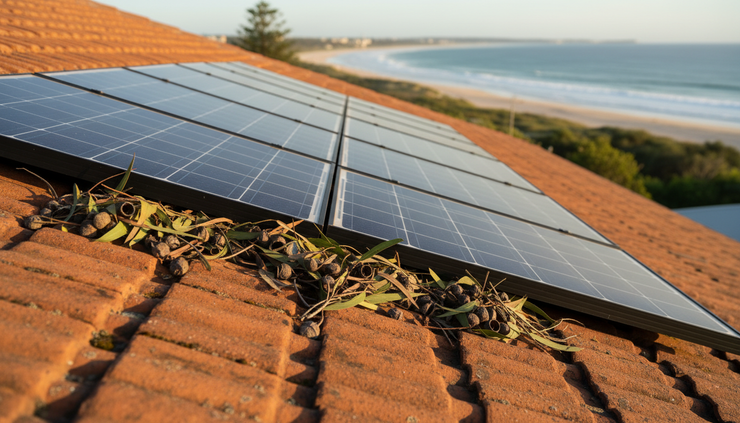
Tree canopy is another common issue. Many homes have nearby gums, palms or other established trees. These bring shade, leaves, pollen, sap and bird activity. Even partial shading can reduce solar output, and physical debris can sit along the lower edge of panels.
Bird droppings are one of the more serious problems because they block light completely in patches. If droppings sit in the wrong place, they may affect the output of more than the small area they cover.
Common local causes of dirty panels include:
Coastal salt spray and moisture
Fine dust and road grime
Pollen and seed pods
Gum leaves and small branches
Tree sap
Bird droppings
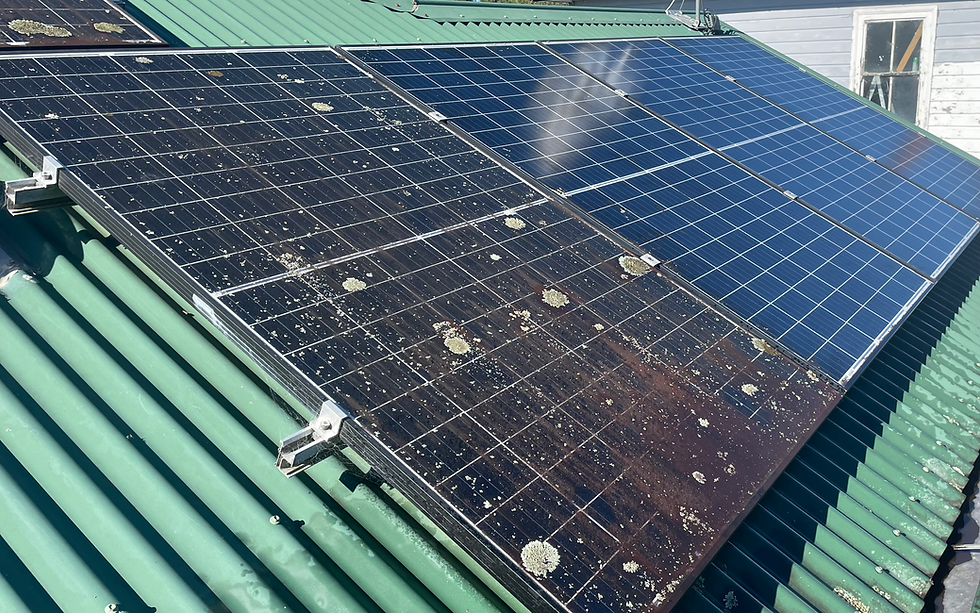
Lichen or mould growth around panel edges
Rain helps, but it is not the same as a proper clean. Rainwater usually runs over the glass. It may leave residue behind, especially when grime has baked onto the surface through hot weather.
Why a small loss can hurt more than expected
A 10% output loss may sound manageable. In practice, it can affect the best hours of the day.
Solar savings are most valuable when the household is using power at the same time the panels are generating. For many families, this includes:
Washing and drying clothes during school hours
Running the dishwasher after breakfast
Cooling the home before everyone gets back
Heating hot water on a timer
Charging devices, tools or batteries during daylight
Running the pool pump through the middle of the day
If the system is down by 10% to 30%, those loads may pull more from the grid. The household may not notice straight away because appliances still work as normal. The evidence often appears later in the bill or in the solar monitoring app.
There is also a compounding effect. A home may have invested in timers, smart appliances or habits designed around daytime solar production. Dirty panels weaken the return from all those decisions.
That is why the question is not only “Are the panels still working?”
A better question is: Are they producing enough to deliver the savings the household planned for?
How to tell whether dirty panels are costing money
The easiest way to spot a problem is to compare expected output with actual output.
Most solar inverters and monitoring apps show daily, weekly and monthly generation. A single cloudy week does not prove anything. But a long-term drop during similar weather can be a warning sign.
Look for these signs:
Output is lower than similar months in previous years
One string or section performs worse than the rest
Generation drops sharply despite clear skies
Panels look dull, streaky or patchy from the ground
Bird droppings or leaves are visible
Trees now shade panels more than when the system was installed
Electricity bills have crept up despite the same usage habits
A simple check is to pick a clear, mild day and look at generation around the middle of the day. Compare this with past clear days in the same season if your monitoring app stores history.
Keep in mind that solar output naturally changes with the season. Winter production is lower than summer production, and cloudy coastal weather can reduce output significantly. The goal is to look for patterns, not one-off dips.
Cleaning is about output and safety
Cleaning solar panels sounds simple, but rooftops are risky. Wet glass, roof pitch, ladders and electrical equipment are not a good mix.
For most homeowners, it is safer to avoid climbing onto the roof. A professional solar panel cleaner should use suitable equipment, avoid harsh chemicals, and work in a way that protects the panels, wiring and roof surface.
Poor cleaning can cause damage. Abrasive tools may scratch the glass. Strong chemicals may affect seals or coatings. High-pressure cleaning used incorrectly may force water where it should not go.
A proper clean should focus on:
Removing salt film and dust without scratching glass
Clearing droppings, sap and baked-on residue
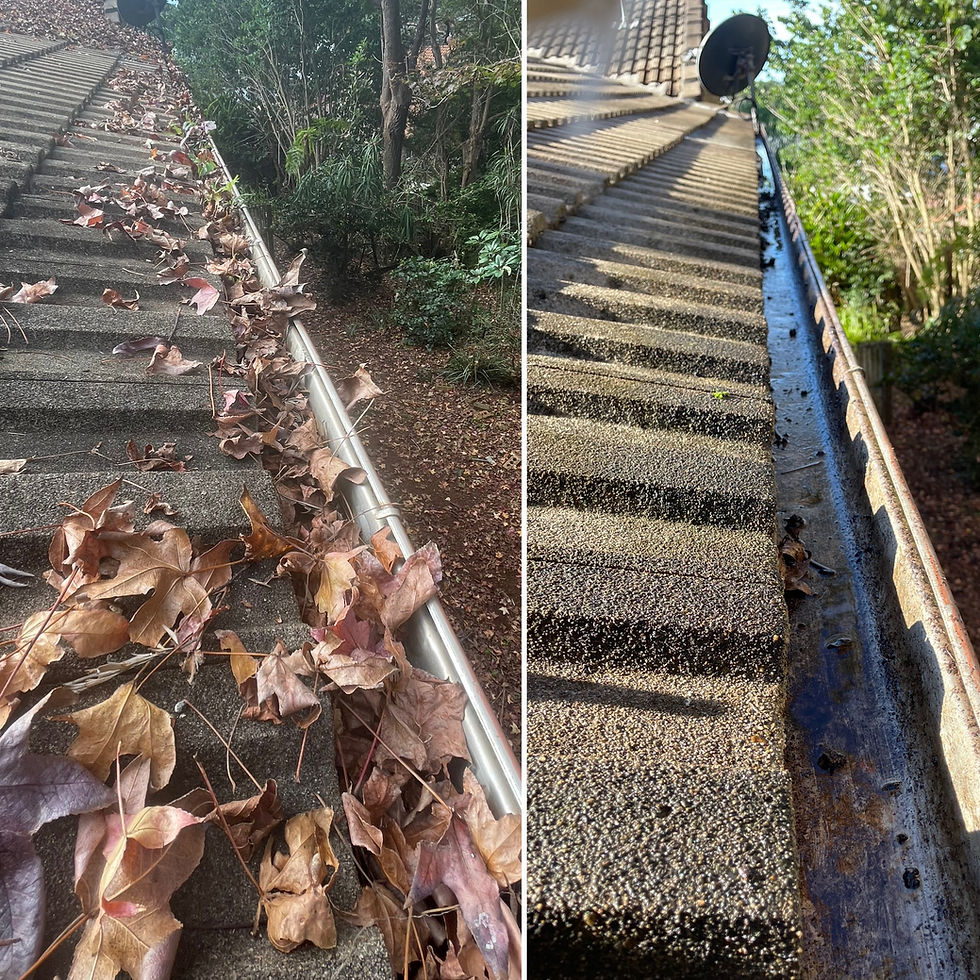
Removing leaves and debris from panel edges
Checking for obvious shading or build-up issues
Avoiding pressure or impact on panel frames and cables
Cleaning frequency depends on the site. A clear, steep roof with little tree cover may need less attention. A flatter roof near trees or close to salt air may need cleaning more often.
The best approach is to link cleaning decisions to performance. If the system output is dropping and there is visible grime, the financial case becomes easier to judge.

When cleaning pays for itself
The numbers do not need to be complicated.
If a 6.5 kW system has a 20% loss, the estimated lost value may be around $365 per year. If cleaning restores most of that output, the financial benefit can be meaningful.
If a 10 kW system has a 20% loss, the estimated lost value may be around $561 per year. At a 30% loss, the estimate rises to about $841 per year.
The key word is “if”. Cleaning pays best when dirt is a real cause of lost output. If the issue is shading from a new tree branch, inverter faults, panel degradation or a metering problem, cleaning alone will not fix it.
A practical process is:
Check the monitoring data.
Look for visible dirt, droppings, leaves or sap.
Compare output with past performance.
Clean the panels safely if soiling appears likely.
Check whether generation improves in similar weather.
That final step matters. It turns cleaning from a guess into a measurable result.
The takeaway for Port Macquarie households
Dirty panels do not just reduce solar generation. They reduce the most valuable part of solar generation, the power used inside the home instead of bought from the grid.
With low feed-in tariffs, a lost kilowatt-hour is often worth far more than 3 cents. For a household using much of its solar during the day, the real value may sit closer to the blended saving used in the examples above.
For a Port Macquarie family with a 6.5 kW or 10 kW system, a neglected array can quietly cost anywhere from a couple of hundred dollars to well over $800 a year, depending on the level of soiling and how the home uses power.
The smartest move is to treat panel cleanliness as part of system performance, not just roof maintenance. Check the data, look for visible build-up, and keep the panels clear enough to do the job they were installed to do.

Comments